Date Published: 2026/08/06
Read Time: mins
How to create the perfect boat safety kit
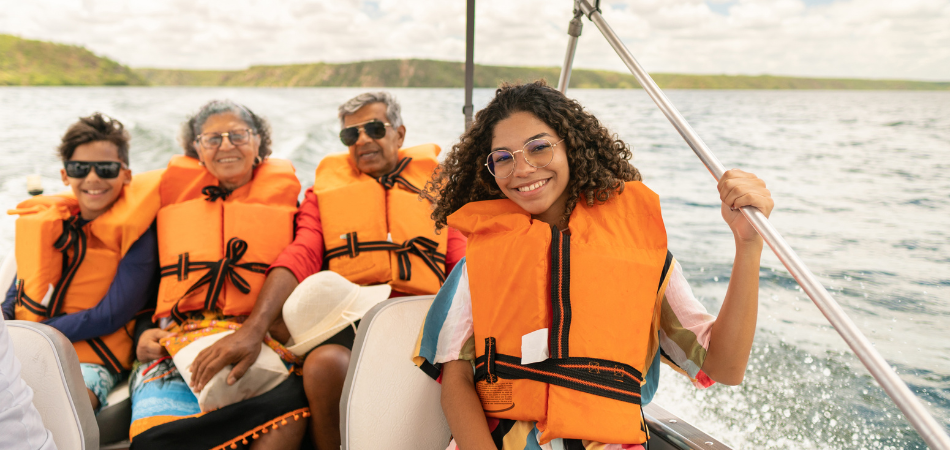
Before you head out on your next waterfront adventure, make sure you have all the necessary boat safety equipment, so you don’t have to worry about lacking essentials if an emergency arises.
Important safety information
Transport Canada has a very detailed Safe Boating Guide that provides specific information about the rules and regulations that must be followed based on the size and type of watercraft you're operating. Review this guide to verify you're aware of all legal requirements that apply to your specific make, model, and size of watercraft before heading out on the water.
Ready to get started? Here’s what you need to know about assembling your boat safety kit.
Boat safety kit: The essentials
Be ready to hit the water by making sure your watercraft has all the following safety essentials on board.
Life jackets
Whether you’re piloting a rowboat or a luxurious yacht, you are required by law to have a life jacket for every person on board1. If you accidentally fall into the chilly water, you’ll be glad you have the life jacket keeping you afloat until help arrives. Otherwise, cold-water shock and any resulting injuries could lead to tragedy.
Flotation device
A throwable flotation device is an essential piece of safety equipment in case someone falls overboard. Attempting to rescue a person who is drowning can be extremely dangerous2. A ring buoy, flotation cushion, or similar device can be thrown to the person to help keep them afloat while they are safely brought back to the boat.
Distress signals
Your boat should have a working VHF-FM radio3 on hand just in case you need to call for help through Channel 16. On top of that, you need visual and audible distress signals on hand. On the audible side, whistles, bells, and fog horns work best. As for visual signals, bring vivid orange flags, a flare gun, a strobe light, and an ultra-bright waterproof flashlight.
First aid kit
Cuts, sunburns, and even bee stings can all occur while out boating. So, you should have a first aid kit on hand to provide immediate support in the event of an injury, illness, or allergic reaction.
Your kit should have:
- Bandages
- Gauze pads
- Medical tape
- Alcohol wipes
- Antibiotic ointment
- Ice pack
- Tweezers
- Scissors
- Non-latex gloves
- Thermometer
- Multitool
- Over-the-counter pain medication
- Allergy medication
- Emergency blanket
- Sunblock
- Aloe vera gel
You can either buy a pre-made kit and then add whatever extra items you think you’ll need. Or just buy all the items separately and put them in a waterproof box.
Fire extinguishers
If your boat uses fuel for its motor, cooking equipment, and the like, then you must have a fire extinguisher on board. You’ll need to get at least one Class 5B:C or 10B:C fire extinguisher to stay in compliance with the law. The exact type and total number of fire extinguishers required depend on your vessel's size.4
Additional boat safety items
Other boat safety equipment to have on board includes:
- Extra water
- Protein-rich snacks
- Compass
- Oars
- Bilge pump (or bucket)
- Anchor with 15 metres of rope
- Spare clothes for all passengers
Beyond that, don’t forget to put together a tool kit with a few spare small-engine parts and other components you may need on the water. For more ways to prepare, read our article on water safety planning for new boat owners.
How to store your boat safety equipment
You must store your boat safety kit in a location that is accessible in an emergency. If possible, put all the items you can in a waterproof container. Then, put the life jackets, ring buoy, bilge pump, oars, fire extinguishers, and other emergency equipment in easy-to-reach locations.
No matter where you store the items, go over the locations of all the boat safety equipment with your passengers before each trip. Every person on board should know where to find each item and how to use it best to resolve the matter at hand – even the kids.
Ready to hit the water after building your boat safety kit?
As you make boat safety a top priority, don’t forget the insurance to back it up. With the right level of coverage, you can protect your vessel, navigational equipment, and personal effects. On top of that, an Orbit insurance policy ensures you’re covered in case you cause damage to other watercraft in your vicinity. Contact an Orbit marine insurance expert for personalized advice or request a quote online using the link below. Boat insurance is what we do.
-Home.svg?ext=.svg)
-Auto.svg?ext=.svg)
-Travel.svg?ext=.svg)


-Home.svg?ext=.svg)
-Auto.svg?ext=.svg)
-Boat.svg?ext=.svg)
-Business.svg?ext=.svg)
-Collector.svg?ext=.svg)
-Prize-Indemnity.svg?ext=.svg)
-Motorcycle.svg?ext=.svg)
-RV-Class-A.svg?ext=.svg)
-RV.svg?ext=.svg)
-Travel.svg?ext=.svg)

